
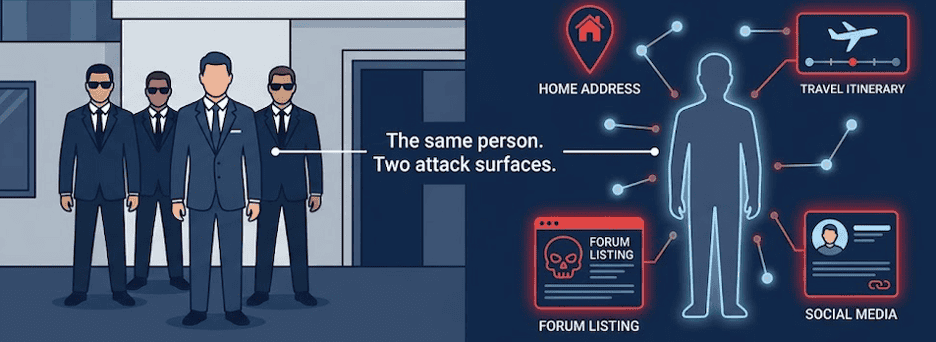
VIP security now means protecting an executive’s online life as well as their physical safety. Attackers collect personal data from data brokers, social media, and public records before they send a single message. The FBI warns that criminals use generative AI to pose as company executives in video chats. Digital protection finds this exposure early and shares it with the physical security team.
When executive data is published, it can be archived, mirrored, and indexed within hours, even if the original site is taken down. Security teams that detect the exposure while it is still live can begin removal requests early. Teams that discover it afterward are left managing the indexed copies.
Executive digital risk moves like this: exposure measured in hours, consequences measured in years. And yet the security programs designed to protect the people at the top of most organizations were built around a different model, one centered on physical presence, access control, and perimeter defense. That model still matters. It is also no longer sufficient.
The personal digital footprint of an executive is now a pre-attack intelligence asset. Attackers do not need to breach your network to target your leadership. They buy data broker profiles, map family members and phone carriers, monitor travel announcements, and build targeting packages from publicly available information before a single phishing email is written. The attack surface is not just what your executives do at work. It is everything they have made visible about themselves online.
| FBI warning criminals use generative AI for real-time video chats with alleged company executives (FBI IC3, 2024) | Oversharing online gives criminals what they need to phish a specific person (CISA) | HK$200M (about US$25 million) lost by Arup in a single deepfake CFO video call attack (2024) |
What Is Executive Digital Risk in VIP Security?
Executive digital risk is the set of threats that originate from an executive’s personal online presence rather than from their corporate role. It overlaps with corporate risk, sometimes substantially, but it is not the same thing and it is not fully covered by the same controls.
A corporate security program protects the organization’s systems, data, and network. Executive digital protection extends that perimeter to cover the individual: their personal email accounts, home network, family members’ digital footprints, public-facing social media, physical location signals derived from travel posts and calendar metadata, and the data that data brokers have assembled and made purchasable for a few dollars per record.
The reason this matters is that attackers have learned to use the personal surface to reach the professional one. A spear phishing email built from data broker profiles is more convincing than one built from a LinkedIn page alone. A deepfake voice call is more credible when it references accurate personal details the victim recognizes as things only their real colleague would know. The personal footprint is the reconnaissance layer that makes every downstream attack more effective.
- Personal data collectedData broker profiles, social media, public records.
- Approach builtMessage or call uses real names, projects and personal details.
- Contact madeSpear phishing email, voice clone call or video call.
- Action requestedA payment, credential or access request that looks internal.
| Why Digital and Physical Risk Are No Longer Separate Executives who travel without a current threat briefing are exposed to risks in volatile regions without context. Doxxing events, in which personal information including home addresses, family details, and daily routines is published publicly, have escalated into physical threats in documented cases. Cybersecurity is now a core executive protection priority, not because physical risk has decreased but because digital exposure increasingly precedes and amplifies physical risk. |
How Does an Executive Become a Target? The Pre-Attack Intelligence Phase
Before any phishing email is sent, any voice clone is activated, or any credential is purchased, there is a reconnaissance phase. For executives, this phase is unusually productive for attackers because executives are unusually visible.
A baseline open-source audit of a single senior executive often surfaces a large number of active data broker records. Each record is a node: a home address, a phone number, a family member’s name, a vehicle registration, a historical employer, a political donation, a property record. Individually, each of these is minor. Assembled into a profile, they provide enough context to craft an approach that does not look like an attack.
| Data Source | What It Reveals | How Attackers Use It |
| Data broker aggregators | Home address, family members, phone carriers, vehicle registration, property records | Social engineering scripts, physical surveillance planning, SIM swap targeting |
| LinkedIn and professional networks | Reporting lines, direct reports, travel conference schedule, recent deals and announcements | Whaling lure construction, impersonation of known contacts, org chart mapping |
| Conference and event listings | Travel schedule, geographic location on specific dates, speaking engagements | Physical threat planning, location-specific phishing timed to travel |
| Social media personal accounts | Home location signals, family members, routines, vehicle details visible in photos | Deepfake training data for voice and appearance, personal detail for BEC credibility |
| Dark web breach databases | Personal email credentials, historical passwords, financial account fragments | Credential stuffing against personal accounts, escalation to corporate access |
| Public records and filings | Equity compensation, home purchase records, business registrations, court documents | Financial targeting, extortion leverage, corporate intelligence |

How Is Executive Targeting Executed? The Four Primary Attack Paths
Attack Path 1: Doxxing and Personal Data Publication
Doxxing is the deliberate publication of an executive’s personal information, typically home address, family member identities, and contact details, on public forums or dedicated websites. Its purpose is dual: it enables anyone who finds it to act on the information, and it creates psychological pressure on the target and their family that can influence organizational decisions.
Published data can be copied and indexed quickly, and the indexed copies persist. Takedown requests rarely land within the window that matters, because the gap between first exposure and first exploitation can be measured in hours, not days.
Attack Path 2: Whaling and Spear Phishing Built from Personal Data
Whaling is spear phishing directed at senior executives. What distinguishes it from general phishing is the investment in personalization: attackers use the reconnaissance phase to construct approaches that reference real projects, real colleagues, and real personal details in ways that make the message appear internally credible.
CEO fraud, which involves impersonating an executive to redirect a payment or credential, is a common attack. The attack does not require breaking any system. It requires constructing a message convincing enough that someone with authorization takes a requested action. Personal digital exposure is the primary input to that construction process.
Attack Path 3: Deepfake Voice and Video Impersonation
Voice synthesis tools now need only a short recording to generate a usable clone of an executive’s voice. Most executives have hours of accessible audio on earnings calls, conference presentations, and media appearances.
The Arup case in 2024 demonstrated what this attack looks like at full scale: a finance employee received a video call in which every other participant, including the CFO and several senior executives, was an AI-generated deepfake. The employee authorized 15 transfers totaling HK$200 million (about US$25 million) in a single session. Every participant on the call was fabricated. The only real person present was the victim.
Deepfake-as-a-Service platforms, which grew significantly in availability through 2025, have removed the technical barrier for this attack type. An attacker does not need video production skills. They need a subscription and a target with sufficient public audio and video material.
Attack Path 4: Travel Schedule Exploitation
An executive’s physical location on a specific date is intelligence. It enables physical threat planning, location-specific social engineering, and targeted phishing timed to moments when the executive is isolated, in transit, or operating outside their normal security context.
Conference announcements, LinkedIn posts about speaking engagements, press releases about deal signings, and even tagged photographs create a predictable pattern of location and schedule. When executives are not briefed before travel, the executive security program does not know the risk they are walking into, because the digital monitoring program has not surfaced it.
| The Physical Consequence of Digital Exposure Doxxing events that include home addresses and family member names have preceded credible physical threats in documented incidents. The escalation path from data publication to physical risk is not theoretical. It has occurred. Organizations whose executive protection programs operate as entirely separate functions from their digital risk monitoring programs are, by design, unable to connect the signal to the consequence until after both have happened. |
What Is Being Sold About Your Executives on the Dark Web?
Dark web exposure for executives is not hypothetical and it is not limited to corporate credentials. Personal identifiers, account credentials from personal email and financial services, and packaged intelligence profiles are all available for purchase, at price points that reflect the value an attacker expects to extract.
| Data Category | What It Enables | Where It Originates |
| Personal email credentials | Account takeover, historical email access, password reuse against corporate SSO | Consumer data breaches, phishing, infostealer logs |
| Home address and family member identities | Physical threat, doxxing amplification, social engineering personalization | Data brokers, public records, aggregator leaks |
| Phone number and carrier details | SIM swap attack, vishing campaign, two-factor bypass | Data brokers, telecom breach databases |
| Financial account fragments | Targeted fraud, spear phishing lure construction, extortion leverage | Financial service breaches, dark web aggregators |
| Travel and schedule intelligence | Physical threat planning, location-specific attack timing | Conference databases, social media scraping, corporate press releases |
| Voice and video samples | Deepfake construction, voice clone for vishing | Public earnings calls, conference recordings, media appearances |
| Personal device identifiers | Device targeting, mobile malware delivery, SIM swap correlation | App breach databases, device fingerprint markets |
How to Build an Integrated Executive Digital Protection Program
An integrated program is not a collection of separate tools. It is a coherent function that connects personal digital footprint monitoring, corporate threat intelligence, and physical security operations into a shared picture. The three components feed each other: a dark web alert about an executive’s personal email credential informs both the IT response and the physical security team’s threat assessment for any planned travel in the near term.
- Digital footprint monitoringPersonal exposure of the executive and family.
- Corporate threat intelligenceDark web alerts and threat actor activity.
- Physical security operationsTravel and on-site protection.
Layer 1: Digital Footprint Assessment and Reduction
- Conduct a baseline open-source intelligence audit of each covered executive to map current exposure across data brokers, search indexes, and social media
- Identify and initiate removal requests for data broker records containing home addresses, family member details, and personal phone numbers
- Establish an ongoing monitoring cadence so that new data broker publications and public exposure events are surfaced within hours, not weeks
- Develop and communicate a personal digital hygiene framework for executives and their family members: separate personal and professional accounts, location sharing controls, public post review before publication
Layer 2: Dark Web and Threat Intelligence Monitoring
- Monitor dark web sources for executive names, personal email addresses, home addresses, and family identifiers appearing in breach databases, forum discussions, and marketplace listings
- Track threat actor forums and channels for targeting discussions that reference your executives by name, role, or organization
- Integrate executive personal identifier monitoring with corporate dark web monitoring so that a personal breach that exposes corporate credentials surfaces in the same alert pipeline
- Establish specific alert thresholds for travel-correlated exposure, so that increased targeting activity around an executive’s upcoming public appearance triggers a physical security review
Layer 3: Attack Surface and Impersonation Monitoring
- Monitor certificate transparency logs and domain registration activity for lookalike domains being built around executive names and identities
- Track social media for impersonation accounts using an executive’s name, photograph, or biographical details
- Monitor for AI-generated or deepfake content referencing covered executives, particularly on platforms where voice and video clones are used for fraud
- Establish out-of-band verification protocols for any financial or access request that arrives through an executive’s name or identity, regardless of the channel
Layer 4: Physical and Digital Integration
- Brief executives and their physical security teams on digital exposure findings before any travel to high-risk or high-profile locations
- Include travel schedule review in the digital monitoring program so that public announcements of executive presence are flagged and assessed for threat correlation
- Establish escalation paths that connect digital threat monitoring alerts directly to the physical security function, not just the CISO or IT team
How Brandefense Covers This
| Capability | What It Does for Executive Protection |
| Personal identifier monitoring | Tracks executive names, personal emails, home addresses, and family identifiers across dark web sources, data broker aggregators, and breach databases |
| Credential exposure detection | Surfaces personal email and account credentials appearing in infostealer logs and breach dumps before they are exploited |
| Social media impersonation detection | Identifies accounts using executive names, photographs, or biographical details to impersonate covered individuals |
| Lookalike domain monitoring | Flags newly registered domains built around executive names and identities, used for phishing or fraud infrastructure |
| Dark web forum and channel surveillance | Monitors threat actor communication for targeting discussions that reference covered executives |
| Travel and event correlation | Correlates public executive location signals with threat actor activity patterns to surface elevated risk windows |
| 24/7 continuous monitoring | Provides real-time alerting rather than periodic assessment, closing the gap between first exposure and first response |
Frequently Asked Questions
Should executive digital protection be a separate budget line, or part of the existing DRPS contract?
It depends on who owns the risk and who signs off on the response. Where executive exposure is handled by the same security team that owns brand and domain monitoring, keeping it inside the DRPS contract avoids duplicate tooling and duplicate alert queues. Where it is owned by physical security, legal or the office of the CEO — and where the response involves takedown of personal data, family exposure or travel information — a separate line is usually easier to govern, because the approval chain and the data handling rules are different.
What questions decide it in practice?
Four: who receives the alert when an executive’s personal data appears; who is authorized to request a takedown on a private individual’s behalf; whether executive monitoring extends to family members and personal accounts; and whether the reporting goes to the security dashboard or to the board.
What is usually already covered inside a DRPS contract?
Impersonation of executives on social media, executive-themed phishing domains, and credentials belonging to corporate executive accounts appearing in leaks. These are corporate-identity threats and fall inside standard brand and domain monitoring.
What usually needs to be scoped separately?
Personal data exposure of the individual and their household, deepfake audio and video of named individuals, travel and location exposure, and monitoring of personal accounts that are not corporate assets. These require explicit consent and a defined data handling boundary.
Does Brandefense sell executive protection separately?
Brandefense covers executive impersonation and executive credential exposure within its Digital Risk Protection modules, and offers extended personal exposure monitoring for named individuals. Which parts apply to a given organization is scoped during evaluation.
| RELATED READING: Why Your CISO Is Your Organization’s Highest-Value Attack Target: /blog/ciso-highest-value-attack-target : why attackers go after security leadership and what it means for security teams Vishing and Ransomware: /blog/vishing-ransomware-attack-chain : how deepfake voice attacks feed into broader enterprise compromise chains Lookalike Domains: /blog/lookalike-domains-brand-impact : how executive identity impersonation extends to domain infrastructure |